


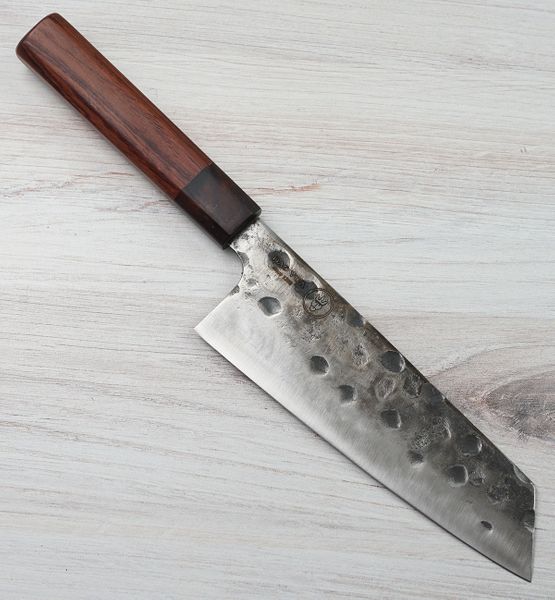
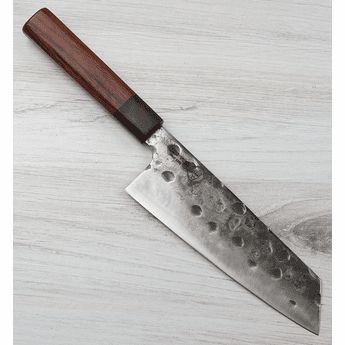
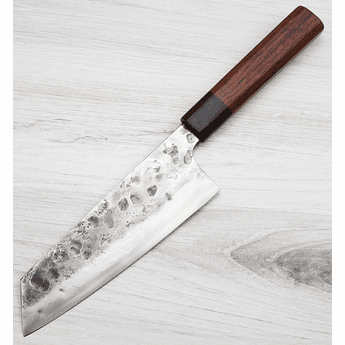
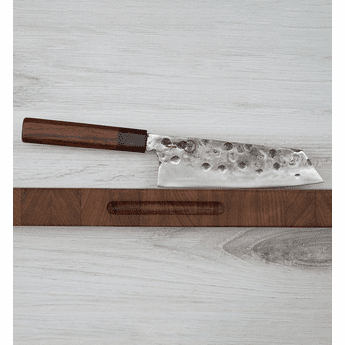
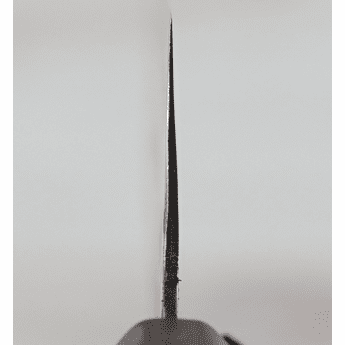


Daovua 52100 Bunka 165mm. Daovua has recently imported some high-quality carbon steel from the USA called 52100, and this promises to improve the quality and performance of their knives. 52100 is a carbon alloy steel originally developed in 1905 for ball bearings and is used for blades of all kinds, including kitchen knives.
Each knife is made by hand so all measurements are approximations.Maker: Daovua
Location: Vietnam
Steel: 52100
Edge: Even
Weight: 4.6 oz (130 g)
Blade Length: 164 mm
Total Length: 310 mm
Spine Thickness at Heel: 3 mm
Blade Height: 47 mm
Handle: Octagonal (color and wood type vary)
Photos by Gustavo Bermudez
Each knife is made by hand so all measurements are approximations.

Reviews
 3 review(s) WRITE A REVIEW (Reviews are subject to approval)
 Wanted to love them, September 9, 2025
Posted By: James
1 people found this review helpful
Really love supporting this maker. I tell everyone about them. But my latest purchase wasn’t up to par. Geometry is all off, giving me a wavy sharpening line. But that’s not my I’m writing a review. Was just spatchcocking a chicken and got a 1/4in x 1/2in chip on the blade edge…not sure if it’s a tempering problem or a steel problem, but this shouldn’t happen from a chicken spine.
1 people found this review helpful
Really love supporting this maker. I tell everyone about them. But my latest purchase wasn’t up to par. Geometry is all off, giving me a wavy sharpening line. But that’s not my I’m writing a review. Was just spatchcocking a chicken and got a 1/4in x 1/2in chip on the blade edge…not sure if it’s a tempering problem or a steel problem, but this shouldn’t happen from a chicken spine.
 Impressively sharp out of the box
Posted By: Gregory
27 people found this review helpful
Excellent beginner knife for someone looking for a high carbon steel blade that’s ready to go out of the box. Great price for a simple, easy to care for, no frills blade that’ll last a long time. 132g is extremely comfortable with a pinch grip.
27 people found this review helpful
Excellent beginner knife for someone looking for a high carbon steel blade that’s ready to go out of the box. Great price for a simple, easy to care for, no frills blade that’ll last a long time. 132g is extremely comfortable with a pinch grip.
First impression Posted By: Larry Johnson
49 people found this review helpful
Very light blade. Decent taper down to the edge. Sharp enough ootb; I touched it up on a Binsui then a progression on denim (3 micron diamond ), then balsa (1 micron diamond). I got a sharp and polished edge that cut well. It didn’t get a major workout, but it glided through Tri tip and pork tenderloin with ease.
The steel is very reactive and immediately started to form a patina. I’m guessing it will be gray before too long. I’m good with that; it will stay in my main rotation along with a Chuka bocho and a couple of petties.
It’s a little rough around the choil, and the spacer between the handle and ferrule is a bit rough. But the nashiji finish is nice and it is well balanced.
I’ll follow up on the edge retention soon.
49 people found this review helpful
Very light blade. Decent taper down to the edge. Sharp enough ootb; I touched it up on a Binsui then a progression on denim (3 micron diamond ), then balsa (1 micron diamond). I got a sharp and polished edge that cut well. It didn’t get a major workout, but it glided through Tri tip and pork tenderloin with ease.
The steel is very reactive and immediately started to form a patina. I’m guessing it will be gray before too long. I’m good with that; it will stay in my main rotation along with a Chuka bocho and a couple of petties.
It’s a little rough around the choil, and the spacer between the handle and ferrule is a bit rough. But the nashiji finish is nice and it is well balanced.
I’ll follow up on the edge retention soon.



