


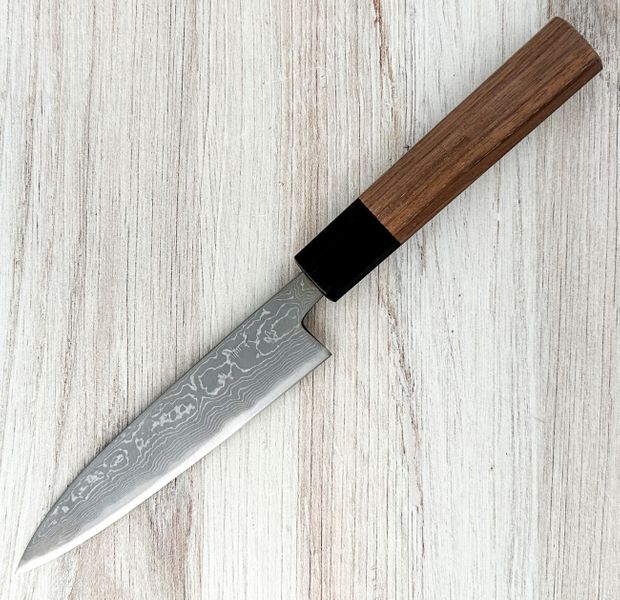
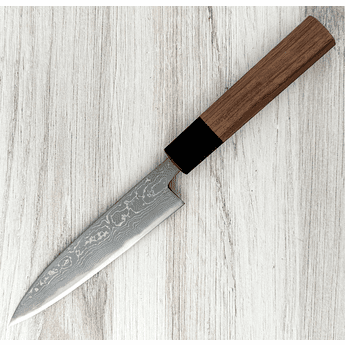
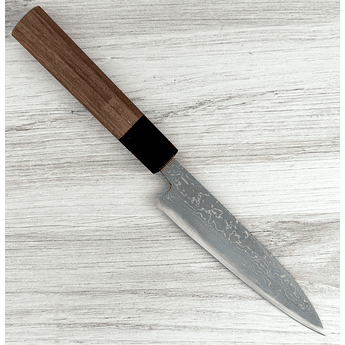
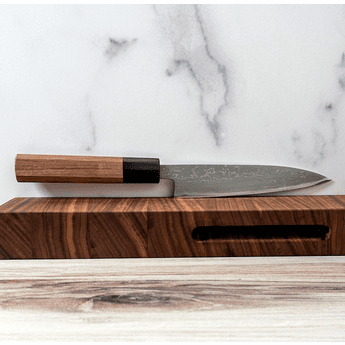
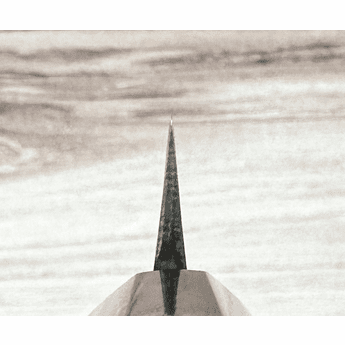


The Yamashin Blue #2 Damascus Petty 135mm is a compact, hand-forged Japanese utility knife that is great for small prep work, trimming, peeling, and in-hand cutting tasks. Made by Yamashin in Tosa, Japan, this petty gives you a nice mix of traditional carbon steel performance, Damascus good looks, and a comfortable wa handle at a very approachable price for a handmade Japanese knife.
The cutting core is Hitachi Blue #2, also known as Aogami #2, a high-carbon Japanese steel known for excellent edge retention and responsive sharpening. Blue #2 is a favorite among cooks who enjoy carbon steel because it takes a very keen edge and is easy to bring back on water stones. The core is wrapped in reactive Damascus cladding using san mai construction, which gives the blade added visual depth while supporting the harder cutting steel.
At about 135mm, this petty knife is a useful size for jobs that feel too small for a gyuto or santoku. It works well for cutting fruit, trimming vegetables, slicing small proteins, cleaning mushrooms, working around stems, and doing quick board work when you do not want to pull out a larger chef knife. The double bevel grind makes it comfortable for both right- and left-handed cooks.
The Damascus migaki finish gives the knife a lively, layered look, while the octagonal walnut handle with black pakka wood ferrule keeps the knife light, nimble, and easy to control. Like most Yamashin knives, this one has a rustic handmade feel and offers a lot of performance for the money. Each knife is made by hand, so small variations in measurements and finish are normal.
Care Instructions: This knife has a reactive carbon steel core and reactive Damascus cladding, so it may develop a natural patina with use. Hand wash only and dry thoroughly after use. Do not put it in the dishwasher. Avoid cutting frozen foods, bones, hard squash stems, or very hard materials. As with most harder Japanese kitchen knives, avoid twisting the edge in dense foods to prevent chipping. Store in a blade guard, block, saya, or on a magnetic strip to protect the edge.
The cutting core is Hitachi Blue #2, also known as Aogami #2, a high-carbon Japanese steel known for excellent edge retention and responsive sharpening. Blue #2 is a favorite among cooks who enjoy carbon steel because it takes a very keen edge and is easy to bring back on water stones. The core is wrapped in reactive Damascus cladding using san mai construction, which gives the blade added visual depth while supporting the harder cutting steel.
At about 135mm, this petty knife is a useful size for jobs that feel too small for a gyuto or santoku. It works well for cutting fruit, trimming vegetables, slicing small proteins, cleaning mushrooms, working around stems, and doing quick board work when you do not want to pull out a larger chef knife. The double bevel grind makes it comfortable for both right- and left-handed cooks.
The Damascus migaki finish gives the knife a lively, layered look, while the octagonal walnut handle with black pakka wood ferrule keeps the knife light, nimble, and easy to control. Like most Yamashin knives, this one has a rustic handmade feel and offers a lot of performance for the money. Each knife is made by hand, so small variations in measurements and finish are normal.
Care Instructions: This knife has a reactive carbon steel core and reactive Damascus cladding, so it may develop a natural patina with use. Hand wash only and dry thoroughly after use. Do not put it in the dishwasher. Avoid cutting frozen foods, bones, hard squash stems, or very hard materials. As with most harder Japanese kitchen knives, avoid twisting the edge in dense foods to prevent chipping. Store in a blade guard, block, saya, or on a magnetic strip to protect the edge.
- Maker: Yamashin
- Location: Tosa, Japan
- Item #: KJ-ADM-135PT
- Knife Type: Petty / Utility Knife
- Construction: San Mai, Hammer Forged
- Core Steel: Hitachi Blue #2 / Aogami #2
- Cladding: Damascus, Reactive
- Finish: Damascus Migaki
- Grind: Double Bevel
- Handle: Octagonal Walnut
- Ferrule: Black Pakka Wood
- Weight: 2.6 oz / 76 g
- Blade Length: 138 mm
- Total Length: 265 mm
- Spine Thickness at Heel: 3 mm
- Blade Height: 28 mm
- Made in Japan




