


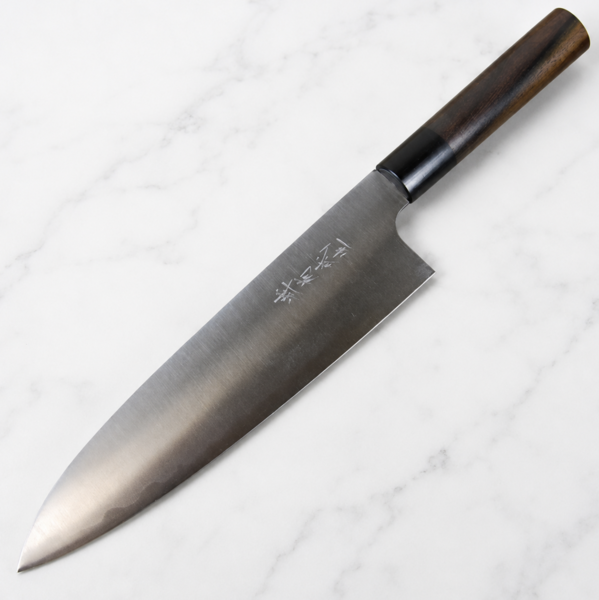


The contrast between the Shiro Kamo kurouchi and migaki lines tells you something useful about the range of his work. The kurouchi surface is dark, textured, and rustic - the as-forged finish left largely intact from the forge. The migaki (polished) line shows what lies underneath: a san-mai construction of Blue #2 carbon steel core forge-welded into reactive iron cladding, brought to a smooth, reflective polish that reveals the layers clearly. Kamo-san earned the Dento-Kogei-shi title at 47 - Japanese recognition of a master of traditional crafts - and works at Takefu Knife Village in Echizen with a small crew, keeping all production in-house.
At 188mm the gyuto (Japanese all-purpose chef knife) sits at the compact end of the format. It is a knife for cooks who want the versatility of a gyuto - the belly for rocking cuts, the pointed tip for detail work, the length for proteins and larger vegetables - without the commitment of a 210mm or 240mm blade. At 130g it is genuinely light, which makes it comfortable through extended sessions, and the 2.5mm spine tapers toward the tip in a way that keeps the knife responsive rather than wedging through food. The Blue #2 core at 61 HRC is hard enough to hold a fine edge well and sharpens back readily on quality stones. The reactive iron cladding develops a patina with use, adding visual character without affecting performance. Rosewood D handle, black pakkawood ferrule - clean and well-proportioned.
Care Instructions: Blue #2 is a reactive carbon steel that will develop a natural patina with use. The reactive iron cladding will also develop color over time - this is normal and expected. Wipe and dry thoroughly after every use and avoid leaving acidic foods on the edge. Hand wash only - no dishwasher. Apply camellia oil before extended storage. Sharpen on quality water stones and strop regularly to maintain the edge between full sharpenings.
At 188mm the gyuto (Japanese all-purpose chef knife) sits at the compact end of the format. It is a knife for cooks who want the versatility of a gyuto - the belly for rocking cuts, the pointed tip for detail work, the length for proteins and larger vegetables - without the commitment of a 210mm or 240mm blade. At 130g it is genuinely light, which makes it comfortable through extended sessions, and the 2.5mm spine tapers toward the tip in a way that keeps the knife responsive rather than wedging through food. The Blue #2 core at 61 HRC is hard enough to hold a fine edge well and sharpens back readily on quality stones. The reactive iron cladding develops a patina with use, adding visual character without affecting performance. Rosewood D handle, black pakkawood ferrule - clean and well-proportioned.
Care Instructions: Blue #2 is a reactive carbon steel that will develop a natural patina with use. The reactive iron cladding will also develop color over time - this is normal and expected. Wipe and dry thoroughly after every use and avoid leaving acidic foods on the edge. Hand wash only - no dishwasher. Apply camellia oil before extended storage. Sharpen on quality water stones and strop regularly to maintain the edge between full sharpenings.
- Blacksmith: Shiro Kamo
- Location: Echizen, Japan
- Workshop: Takefu Knife Village
- Construction: San Mai, Hammer Forged
- Edge Steel: Blue #2 Carbon Steel (Aogami 2)
- Cladding: Reactive Iron
- Finish: Migaki (Polished)
- HRC: 61
- Edge Grind: Even
- Handle: Rosewood D
- Ferrule: Black Pakkawood
- Weight: 4.6 oz (130g)
- Blade Length: 188mm
- Total Length: 329mm
- Spine Thickness at Heel: 2.5mm
- Blade Height at Heel: 47.9mm




