


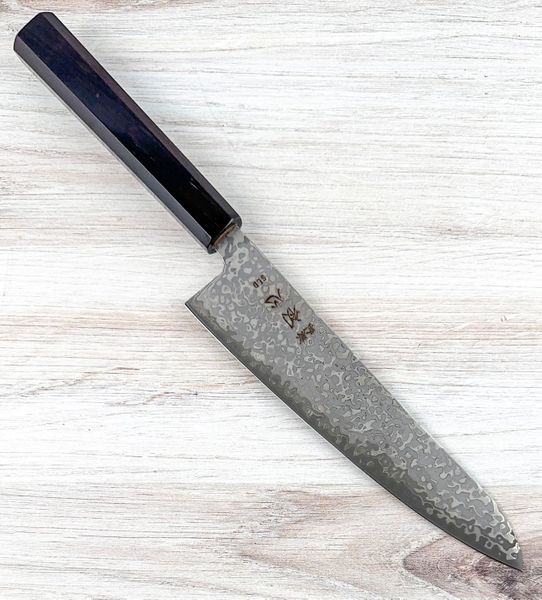
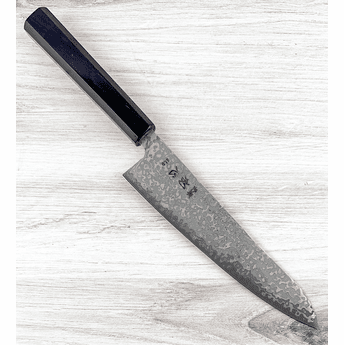
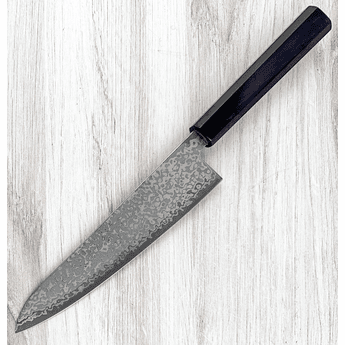
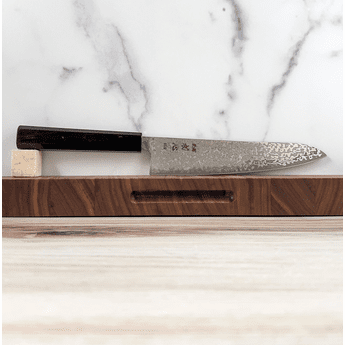
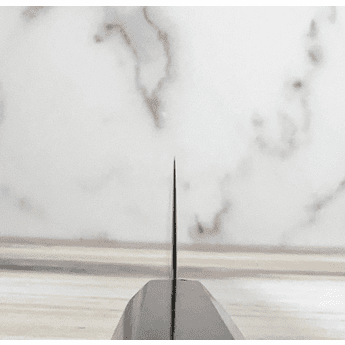


SLD is a semi-stainless tool steel, valued for delivering strong edge retention while staying easier to maintain than a fully reactive carbon steel. Hatsukokoro builds this gyuto around that core out of their shop in Sakai, Japan, in a mid-length size that handles tight kitchens and smaller hands particularly well.
The SLD core is wrapped in stainless Damascus cladding, which improves food release, protects the edge, and gives the blade the flowing layered look the pattern is known for. At 195mm, this gyuto runs fast and nimble, easy to control through long prep sessions without sacrificing the reach needed for slicing proteins and prepping vegetables. The san mai construction carries a subtle convex grind and 50/50 edge, and the octagonal ebony handle provides a comfortable, balanced grip.
Care Instructions: SLD is semi-stainless and hard, which means it holds an edge well but can chip if it meets something it should not. Use wood or rubber cutting boards, avoid bones and frozen foods, and hand wash and dry the blade rather than letting it sit. Strop regularly between sharpenings to keep the edge in top shape.
The SLD core is wrapped in stainless Damascus cladding, which improves food release, protects the edge, and gives the blade the flowing layered look the pattern is known for. At 195mm, this gyuto runs fast and nimble, easy to control through long prep sessions without sacrificing the reach needed for slicing proteins and prepping vegetables. The san mai construction carries a subtle convex grind and 50/50 edge, and the octagonal ebony handle provides a comfortable, balanced grip.
Care Instructions: SLD is semi-stainless and hard, which means it holds an edge well but can chip if it meets something it should not. Use wood or rubber cutting boards, avoid bones and frozen foods, and hand wash and dry the blade rather than letting it sit. Strop regularly between sharpenings to keep the edge in top shape.
- Maker: Hatsukokoro
- Location: Sakai, Japan
- Edge Steel: SLD (Semi Stainless Tool Steel)
- Cladding: Stainless Damascus
- Construction: San Mai
- Edge Grind: Double Bevel, 50/50
- Handle: Octagonal Ebony
- Weight: 4.7 oz (134 g)
- Blade Length: 199 mm
- Total Length: 340 mm
- Spine Thickness at Base: 2 mm
- Blade Height: 43 mm




