


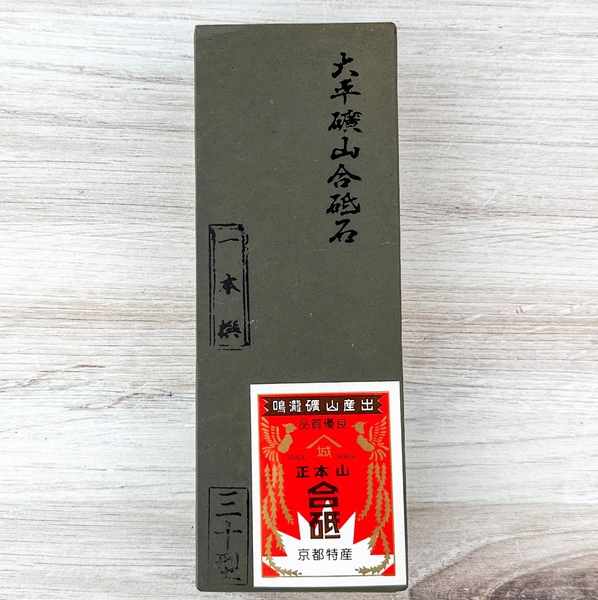
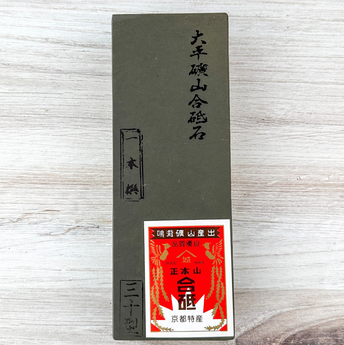
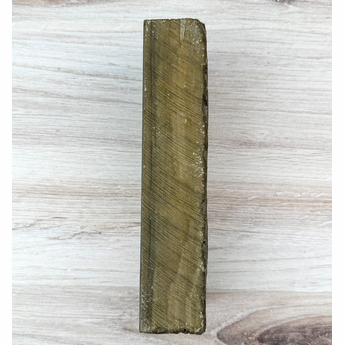


Natural finishing stones from the Kyoto region occupy a category of their own in the sharpening world, and Ohira is one of the most respected names within it. The Ohira mine sits in the mountains northwest of Kyoto near the Umegahata area and Mount Atago, within the Nishimono western mine district that also includes Nakayama and Shobudani — names that serious sharpeners recognize immediately. CKTG sources these stones directly from the Imanishi Stone Company, where each piece is personally evaluated and stamped by Mr. Imanishi before it leaves his hands. That grading process is not a formality. It is a meaningful assessment from one of the most knowledgeable people in the Japanese natural stone trade, and the High Quality stamp on this stone reflects his direct judgment of its character and performance
Ohira Tomae stones are sedimentary mudstones formed during the Cretaceous period as part of the Tamba geological formation — compressed over millions of years into dense layers with extremely fine abrasive particles that produce a finishing surface unlike anything manufactured synthetics can replicate. This particular stone falls in the 8-10K grit range, is firm and hard in feel, and cuts faster than most stones at its level of refinement. The finish it leaves is a refined kasumi (hazy) polish that retains useful edge toothiness — not a pure mirror that slides off food, but a working edge with real bite and a surface that reflects the quality of the steel being sharpened. This stone was mined in the early 1970s and stored carefully in Mr. Imanishi san's basement until recently released. Stones from this region are no longer being actively mined, which makes well-preserved examples from verified sources increasingly difficult to obtain. Each stone is photographed and weighed individually as it sells — what you see is the exact stone you will receive.
What Customers Are Saying: Reviewers who have used other natural finishing stones consistently describe this one as faster and more capable than expected — buttery smooth on the surface but with real cutting speed and exceptional reach. The combination of polishing and toothiness draws particular praise: multiple owners describe an edge that mirrors while still biting, which is the hallmark of a quality natural finisher. First-time Jnat buyers describe the experience as a genuine revelation and return to this stone regularly even after expanding their collections. Several experienced sharpeners note the stone works superbly on both single bevel and hard double bevel knives. The value relative to other Japanese naturals in this quality range is consistently cited as a standout attribute.
Care Instructions: This natural stone is easy to care for and does not require sealing. Wet the surface before use and sharpen as normal. Allow the stone to air dry naturally after each session — do not leave it submerged in water. Store indoors in a temperature-controlled environment at all times. Never store in an unheated garage or shed — if moisture inside the stone freezes, expansion can cause permanent cracking or damage.Stone Type: Ohira Tomae Natural Finishing Stone
Region: Kyoto Natural Stone District (Nishimono), Japan
Mine District: Nishimono (Western Mines)
Approximate Grit Range: 8-10K
Grading: High Quality (Imanishi Stamp)
Mined: Early 1970s
Size: 205mm x 75mm x 40mm
Weight: Approx. 1.7 kg
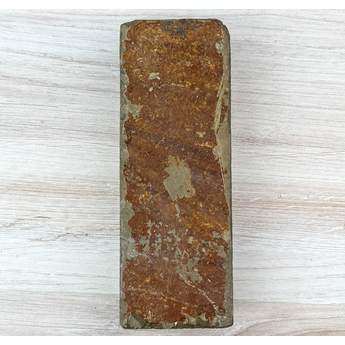
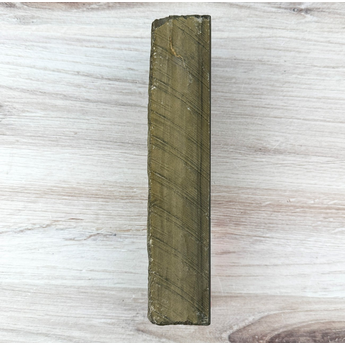
Note: Each stone is photographed and weighed individually — the stone shown is the exact one you will receive
Ohira Tomae stones are sedimentary mudstones formed during the Cretaceous period as part of the Tamba geological formation — compressed over millions of years into dense layers with extremely fine abrasive particles that produce a finishing surface unlike anything manufactured synthetics can replicate. This particular stone falls in the 8-10K grit range, is firm and hard in feel, and cuts faster than most stones at its level of refinement. The finish it leaves is a refined kasumi (hazy) polish that retains useful edge toothiness — not a pure mirror that slides off food, but a working edge with real bite and a surface that reflects the quality of the steel being sharpened. This stone was mined in the early 1970s and stored carefully in Mr. Imanishi san's basement until recently released. Stones from this region are no longer being actively mined, which makes well-preserved examples from verified sources increasingly difficult to obtain. Each stone is photographed and weighed individually as it sells — what you see is the exact stone you will receive.
What Customers Are Saying: Reviewers who have used other natural finishing stones consistently describe this one as faster and more capable than expected — buttery smooth on the surface but with real cutting speed and exceptional reach. The combination of polishing and toothiness draws particular praise: multiple owners describe an edge that mirrors while still biting, which is the hallmark of a quality natural finisher. First-time Jnat buyers describe the experience as a genuine revelation and return to this stone regularly even after expanding their collections. Several experienced sharpeners note the stone works superbly on both single bevel and hard double bevel knives. The value relative to other Japanese naturals in this quality range is consistently cited as a standout attribute.
Care Instructions: This natural stone is easy to care for and does not require sealing. Wet the surface before use and sharpen as normal. Allow the stone to air dry naturally after each session — do not leave it submerged in water. Store indoors in a temperature-controlled environment at all times. Never store in an unheated garage or shed — if moisture inside the stone freezes, expansion can cause permanent cracking or damage.

Reviews
 7 review(s) WRITE A REVIEW (Reviews are subject to approval) Great Natural Finishing Stone, January 13, 2026
Posted By: Adam Y
I have the Ohira Awasedo from another vendor so was wondering how different this would be for doing high polish Kasumi finishes and I was quite surprised. The Awasedo sets up the Tomae to take it to the next level both from a sharpness level and from a polishing perspective. Also considering the cost, the price to performance ratio is really high from my perspective.
I have the Ohira Awasedo from another vendor so was wondering how different this would be for doing high polish Kasumi finishes and I was quite surprised. The Awasedo sets up the Tomae to take it to the next level both from a sharpness level and from a polishing perspective. Also considering the cost, the price to performance ratio is really high from my perspective.
If you get one stone, this is itPosted By: C
56 people found this review helpful
This was the first natural stone I ever got. I have two now. It quite fine and fast for its level of refinement. It leaves a refined edge with some nice bite and polishes, too. I have a bunch of other stones at this point, but still reach for this one often. I also think this is an uncommonly good value in the world of Japanese natural stones.
56 people found this review helpful
This was the first natural stone I ever got. I have two now. It quite fine and fast for its level of refinement. It leaves a refined edge with some nice bite and polishes, too. I have a bunch of other stones at this point, but still reach for this one often. I also think this is an uncommonly good value in the world of Japanese natural stones.
First Jnat and am extremely pleasedPosted By: Mike Hansen
59 people found this review helpful
I have wanted to get into Jnats for quite a while. I finally took the plunge and glad I did. This particular stone is a finishing stone. Preliminary work on synthetic stones should set the bevel and proceed up to 5-6K.
This stone is smooth, does not load up, gives great feedback and can refine the edge to 8-10K. What is remarkable to me, it that while it gives a mirror finish, it still leaves a nice toothiness to the knife. I loves how my knives respond to this stone an recommend it whole heartedly.
59 people found this review helpful
I have wanted to get into Jnats for quite a while. I finally took the plunge and glad I did. This particular stone is a finishing stone. Preliminary work on synthetic stones should set the bevel and proceed up to 5-6K.
This stone is smooth, does not load up, gives great feedback and can refine the edge to 8-10K. What is remarkable to me, it that while it gives a mirror finish, it still leaves a nice toothiness to the knife. I loves how my knives respond to this stone an recommend it whole heartedly.
Great FinisherPosted By: AL_W
57 people found this review helpful
This is my first JNAT. It's a fantastic stone and I was pleasantly surprised. It's buttery smooth yet hard, very fast, and has a lot of reach. I'll be going straight to the Ohira Tomae from a Naniwa Pro 1000. I have no doubt it'll be a fantastic finisher for years to come.
57 people found this review helpful
This is my first JNAT. It's a fantastic stone and I was pleasantly surprised. It's buttery smooth yet hard, very fast, and has a lot of reach. I'll be going straight to the Ohira Tomae from a Naniwa Pro 1000. I have no doubt it'll be a fantastic finisher for years to come.
 First JNat
Posted By: Klaus - verified customer
35 people found this review helpful
Havent used the stone yet its a heavy stone that im shure will do a good job on my knives--like i said in another review when shipping this heavy stone use a more solid box heavyer cardboard and maybe put fragile stickers on it the box was in bad shape when i got it !
35 people found this review helpful
Havent used the stone yet its a heavy stone that im shure will do a good job on my knives--like i said in another review when shipping this heavy stone use a more solid box heavyer cardboard and maybe put fragile stickers on it the box was in bad shape when i got it !
Outstanding!



