


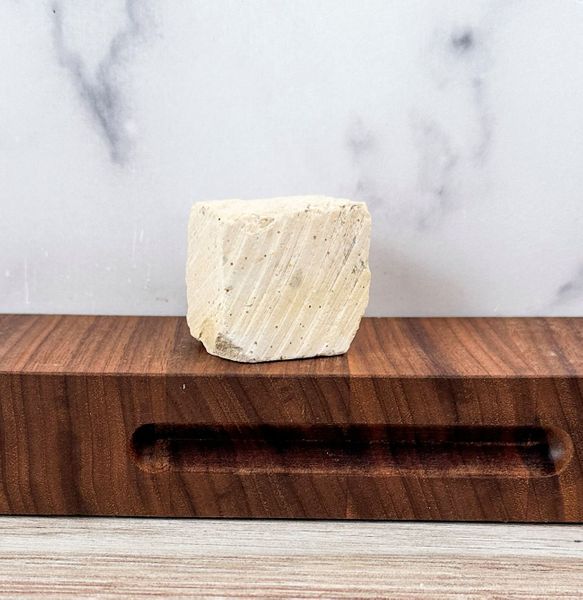
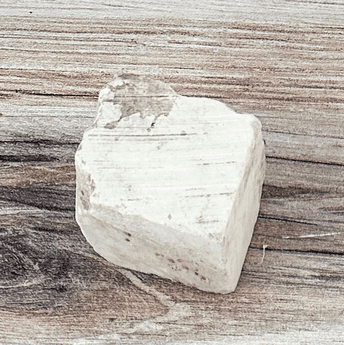
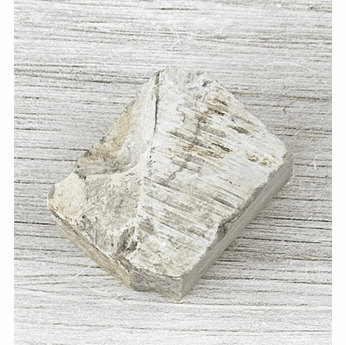
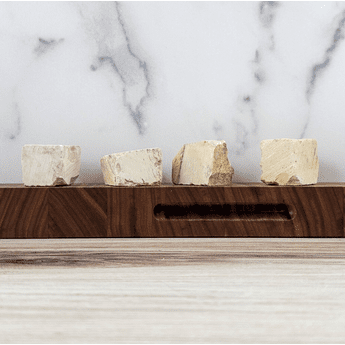


Japanese natural nagura stones are small conditioning stones used to raise a slurry on the surface of larger finishing stones. By rubbing the nagura across the surface of your sharpening stone, it releases fine abrasive particles that mix with water to create a slurry. This slurry improves the performance of your sharpening stone by increasing cutting speed, enhancing polishing ability, and refreshing the surface of fine finishing stones.
Nagura stones are most commonly used with natural finishing stones (Awasedo) and other fine stones in the 4000 grit range and higher. Raising a slurry helps prevent the main stone from glazing over and allows it to cut more consistently while producing a smoother, more refined finish on the edge. Because these stones are natural, each piece will vary slightly in color, shape, and hardness. They are simple splash-and-go tools that require only a little water to quickly produce an effective slurry.
Care Instructions: Wet both the sharpening stone and the nagura before use. Rub the nagura gently across the surface of the stone to raise slurry, then sharpen as normal. Rinse the nagura after use and allow it to air dry completely. Do not perma-soak natural stones. Store indoors in a temperature-controlled environment to prevent cracking from freezing moisture.
Nagura stones are most commonly used with natural finishing stones (Awasedo) and other fine stones in the 4000 grit range and higher. Raising a slurry helps prevent the main stone from glazing over and allows it to cut more consistently while producing a smoother, more refined finish on the edge. Because these stones are natural, each piece will vary slightly in color, shape, and hardness. They are simple splash-and-go tools that require only a little water to quickly produce an effective slurry.
Care Instructions: Wet both the sharpening stone and the nagura before use. Rub the nagura gently across the surface of the stone to raise slurry, then sharpen as normal. Rinse the nagura after use and allow it to air dry completely. Do not perma-soak natural stones. Store indoors in a temperature-controlled environment to prevent cracking from freezing moisture.
- Stone Type: Natural Nagura Slurry Stone
- Origin: Japan
- Use: Slurry production and conditioning finishing stones
- Weight: ~80 g (approximately 3 oz)
- Notes: Size, shape, and color will vary slightly due to the natural material

Reviews
 10 review(s) WRITE A REVIEW (Reviews are subject to approval) "Chu" Nagura
Posted By: Evan - verified customer
37 people found this review helpful
The one I received is a Great little rock. It makes a slurry immediately. The slurry starts out moderately gritty, breaks down quickly, and in time becomes super fine. I will likely buy more.
37 people found this review helpful
The one I received is a Great little rock. It makes a slurry immediately. The slurry starts out moderately gritty, breaks down quickly, and in time becomes super fine. I will likely buy more.
Great It works Nagura A must Product Review Product Review
Posted By: Ozgur - verified customer
35 people found this review helpful
Natural Nagura is a MUST for a Natural Finish/Polishing Stone, like Ohira High Grade (approx. 9-10k grit) and Honyama (8-9k grit)natural stones. Don't use synthetic nagura on natural stones; somehow it is not the same. I use it in a combination of circular and up-and-down motion to further smoothen the stone's surface and also to create a slurry for my yanagi knives. Slurry makes the yanagi knife glide effortlessly over the stone, also helps in polishing action. Without slurry, yanagi knives tend to get stuck over the stone or do not glide well (which may be dangerous as you may end up having cuts in your fingers). As for double bevel knives, like a chef's knife, I use nagura just to clean the surface, then wash it off so that narrow blade road grabs the stone, increasing stone's feedback. However, some prefer washing off the slurry for all kind of knives; or they create slurry out of stone itself bu using a fine diamond stone. Try both ways, and you guys decide.
35 people found this review helpful
Natural Nagura is a MUST for a Natural Finish/Polishing Stone, like Ohira High Grade (approx. 9-10k grit) and Honyama (8-9k grit)natural stones. Don't use synthetic nagura on natural stones; somehow it is not the same. I use it in a combination of circular and up-and-down motion to further smoothen the stone's surface and also to create a slurry for my yanagi knives. Slurry makes the yanagi knife glide effortlessly over the stone, also helps in polishing action. Without slurry, yanagi knives tend to get stuck over the stone or do not glide well (which may be dangerous as you may end up having cuts in your fingers). As for double bevel knives, like a chef's knife, I use nagura just to clean the surface, then wash it off so that narrow blade road grabs the stone, increasing stone's feedback. However, some prefer washing off the slurry for all kind of knives; or they create slurry out of stone itself bu using a fine diamond stone. Try both ways, and you guys decide.
Product ReviewPosted By: Ozgur - verified customer
39 people found this review helpful
A Natural Nagura is a must for a nutural finishing stone, like Ohira High Grade and Honyama stones. I apply a combination of circular and up-and-down motion to smoothen the stone surface and to create slurry for my yanagi knives. I find slurry helpful on yanagi knives, because it helps yanagi glide over the stone and also facilitates extra polishing. Without slurry, a yanagi tends to get stuck on a natural finishing stone. On the other hand, I wash the slurry off when I finish my double bevel knives, like a chef's knife, because slurry decreases stone's feedback (biting into blade) on small blade road of a double bevel knife.
39 people found this review helpful
A Natural Nagura is a must for a nutural finishing stone, like Ohira High Grade and Honyama stones. I apply a combination of circular and up-and-down motion to smoothen the stone surface and to create slurry for my yanagi knives. I find slurry helpful on yanagi knives, because it helps yanagi glide over the stone and also facilitates extra polishing. Without slurry, a yanagi tends to get stuck on a natural finishing stone. On the other hand, I wash the slurry off when I finish my double bevel knives, like a chef's knife, because slurry decreases stone's feedback (biting into blade) on small blade road of a double bevel knife.
Product ReviewPosted By: Stephen - verified customer
23 people found this review helpful
Picked this up for woodworking. I have a J-Nat that is hard and tends to skip when flatting the backs of planes and chisels. This nagura creates a fine smooth paste that makes the tool slide easily on the stone without skipping. It creates a very fine matte finish. I didn't use this stone much up to this point but the finish and edge it creates with this nagura is amazing. I thought this stone was low quality but used with the nagura, I have to say I'm impressed.
23 people found this review helpful
Picked this up for woodworking. I have a J-Nat that is hard and tends to skip when flatting the backs of planes and chisels. This nagura creates a fine smooth paste that makes the tool slide easily on the stone without skipping. It creates a very fine matte finish. I didn't use this stone much up to this point but the finish and edge it creates with this nagura is amazing. I thought this stone was low quality but used with the nagura, I have to say I'm impressed.




