


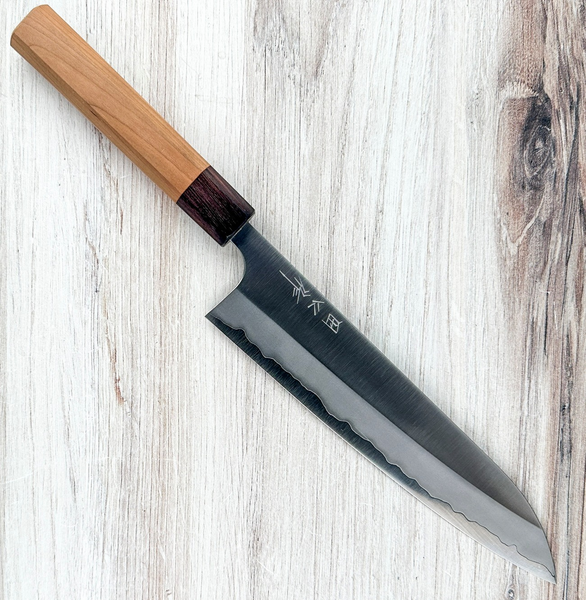
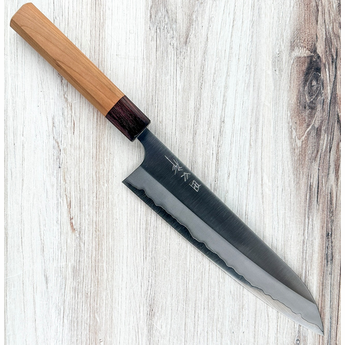
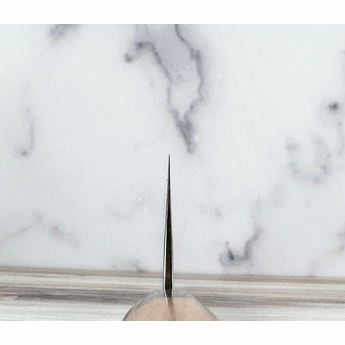


Aogami Super is the steel many sharpeners reach for when edge retention matters most, and in this 210mm gyuto Masato Taguchi forges it as the hard core of a stainless clad san mai blade with a clean polished finish. A wavy line running along the lower blade shows where the stainless outer layers meet the Aogami Super core, and the blade tapers to a fine, thin tip from a 3 mm spine at the heel. Developed by Hitachi as the top of its Blue steel family, Aogami Super adds extra carbon, chromium, tungsten, and molybdenum to the Blue steel recipe, which lets it reach high hardness while staying tough enough for a thin kitchen edge. In practice that means a knife that takes a very keen edge on the stones and keeps cutting cleanly through long prep sessions before it asks for a touch up.
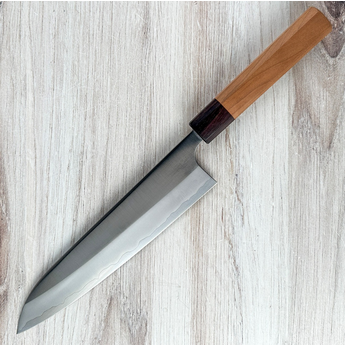
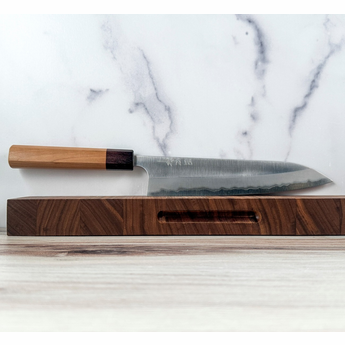
Taguchi-san was born in 1992 and trained in Takefu Village at the workshop of Yoshimi Kato, where he focused on hot forging. Outside of kitchen knives he makes custom hunting knives and is apprenticing in the forging of traditional agricultural hoes, work that has given him a practical feel for how an edge behaves in real use. At 213 mm on the edge and 48 mm tall, this gyuto is the all purpose size that handles proteins, vegetables, and fine knife work in home and professional kitchens alike. At 148 g it comes in a little lighter than his Ginsan version of the same size, and it wears an octagonal cherrywood handle with a walnut ferrule that sets it apart from the walnut handled Taguchi knives.
Care Instructions: The stainless cladding resists rust, but the Aogami Super core exposed along the edge is high carbon steel and can rust or discolor if left wet. Hand wash and dry the blade immediately after each use, and wipe the edge during prep when cutting acidic foods like citrus, tomatoes, or onions. A light patina may form along the edge over time and is normal. Apply a thin coat of camellia oil to the edge before storing for long periods. Store on a magnetic strip or in a blade guard. Do not put in the dishwasher.
Each knife is made by hand so measurements may vary.
- Maker: Masato Taguchi
- Location: Takefu Village, Echizen, Japan
- Born: 1992
- Steel: Aogami Super (Blue Super) Core, Stainless Clad
- Finish: Polished
- Handle: Octagonal Cherrywood
- Ferrule: Walnut
- Weight: 5.2 oz (148 g)
- Blade Length: 213 mm
- Total Length: 363 mm
- Spine Thickness at Base: 3 mm
- Blade Height: 48 mm




