


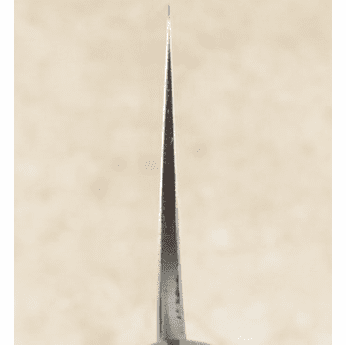


Blue #2 (Aogami 2) carbon steel has earned its place in Japanese professional kitchens through a well-established combination of qualities: good hardness, reliable toughness, and a sharpening response that produces a genuinely sharp edge without demanding specialist technique. Shiro Kamo uses it as the core steel across his Migaki line, forge-welding it into reactive iron cladding and finishing the blade to a polished migaki surface that brings out the san-mai construction clearly. Kamo-san holds the Dento-Kogei-shi title - Japanese designation for a master of traditional crafts - earned at just 47 years old. He works at Takefu Knife Village in Echizen, where he manages every step of production in-house with a small crew.
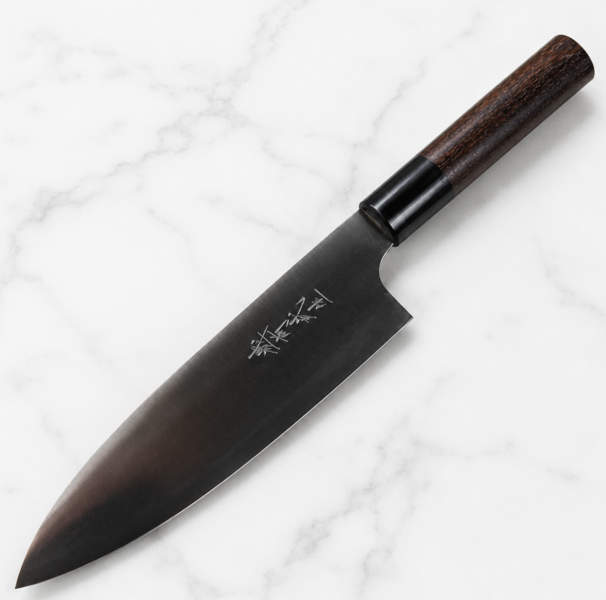
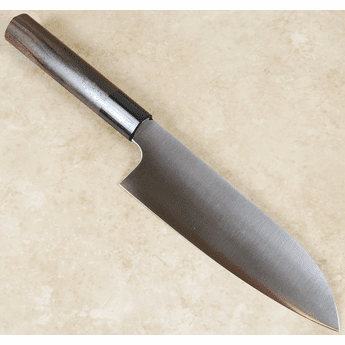
The santoku (three virtues) is one of among the most versatile kitchen formats - designed to handle vegetables, proteins, and fish with equal competence. At 169mm it sits at the standard size for the format, compact enough to be nimble but long enough for most prep tasks. The flat edge profile gives good board contact, and the modest belly allows for rocking cuts when needed. The migaki (polished) iron cladding will develop its own visual character over time as the reactive surface takes on a patina alongside the Blue #2 core at the edge. At 126g the knife is light and fast in the hand. The rosewood D handle and black pakkawood ferrule are well-matched to the blade in both proportion and finish. Note: the blade height on the original spec sheet shows 2.6mm which appears to be a data entry error - please verify before publishing.
Care Instructions: Blue #2 is a reactive carbon steel that will develop a natural patina with use. The reactive iron cladding will also develop color over time - this is normal and expected. Wipe and dry thoroughly after every use and avoid leaving acidic foods on the edge. Hand wash only - no dishwasher. Apply camellia oil before extended storage. Sharpen on quality water stones and strop regularly to maintain the edge.
The santoku (three virtues) is one of among the most versatile kitchen formats - designed to handle vegetables, proteins, and fish with equal competence. At 169mm it sits at the standard size for the format, compact enough to be nimble but long enough for most prep tasks. The flat edge profile gives good board contact, and the modest belly allows for rocking cuts when needed. The migaki (polished) iron cladding will develop its own visual character over time as the reactive surface takes on a patina alongside the Blue #2 core at the edge. At 126g the knife is light and fast in the hand. The rosewood D handle and black pakkawood ferrule are well-matched to the blade in both proportion and finish. Note: the blade height on the original spec sheet shows 2.6mm which appears to be a data entry error - please verify before publishing.
Care Instructions: Blue #2 is a reactive carbon steel that will develop a natural patina with use. The reactive iron cladding will also develop color over time - this is normal and expected. Wipe and dry thoroughly after every use and avoid leaving acidic foods on the edge. Hand wash only - no dishwasher. Apply camellia oil before extended storage. Sharpen on quality water stones and strop regularly to maintain the edge.
- Blacksmith: Shiro Kamo
- Location: Echizen, Japan
- Workshop: Takefu Knife Village
- Construction: San Mai, Hammer Forged
- Edge Steel: Blue #2 Carbon Steel (Aogami 2)
- Cladding: Reactive Iron
- Finish: Migaki (Polished)
- HRC: 61
- Edge Grind: Even
- Handle: Rosewood D
- Ferrule: Black Pakkawood
- Weight: 4.5 oz (126g)
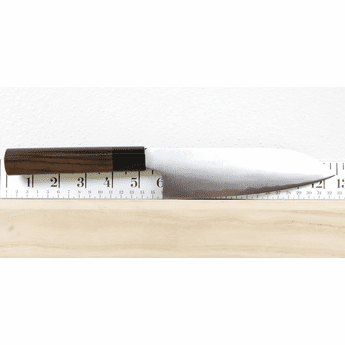
- Blade Length: 169mm
- Total Length: 307mm
- Spine Thickness at Heel: 2.6mm
- Blade Height: 48mm




