




Shiro Kamo received the Dento-Kogei-shi title - Japanese designation for a master of traditional crafts - at just 47 years old, making him one of the youngest blacksmiths ever to earn it. He works at Takefu Knife Village in Echizen, a cooperative of independent craftsmen who share facilities while keeping all production in-house. Within that community, Kamo-san has built a reputation for precision and consistency that has made him one of the most sought-after blacksmiths we carry. Syungo Ogata, another of our featured blacksmiths, trained under him for seven years before striking out on his own.
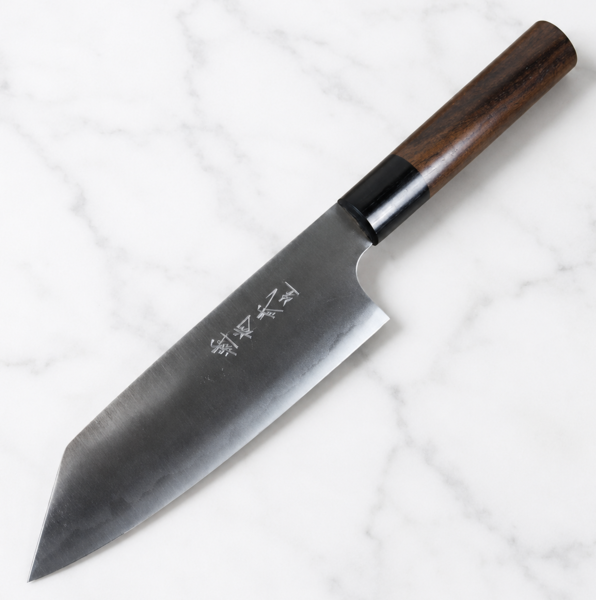
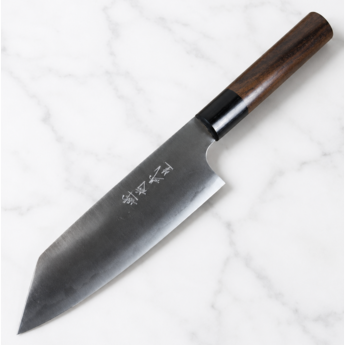
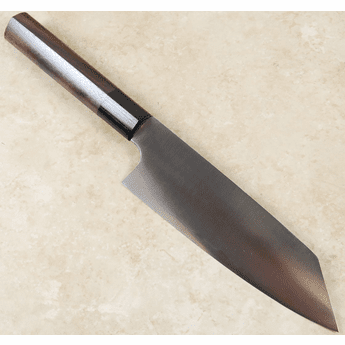
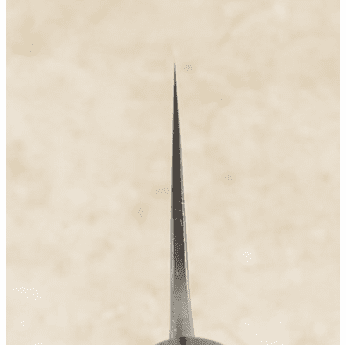
The Blue #2 Migaki line showcases a quieter side of the Kamo-san work. Where his kurouchi knives carry a rugged, as-forged surface, the migaki (polished) finish reveals the construction underneath: a Blue #2 (Aogami 2) carbon steel core forge-welded into reactive iron cladding and brought to a smooth, reflective surface. The contrast between the polished iron jigane (outer cladding steel) and the hagane (inner core steel) at the edge is the kind of detail that becomes more visible as the knife takes on a working patina over time. The bunka format - compact, flat-profiled, with the distinctive reverse tanto tip - handles vegetables, proteins, and aromatics with equal confidence, and the tip opens up fine detail work that a rounded knife cannot match. The rosewood D handle and black pakkawood ferrule are clean and well-finished. At 167mm and 118g it is a light, nimble knife that moves quickly through prep work without fatigue.
Care Instructions: Blue #2 is a reactive carbon steel and will develop a natural patina with use. The reactive iron cladding will also develop color over time - this is normal and expected. Wipe and dry the blade after every use and avoid leaving acidic foods on the edge. Hand wash only - no dishwasher. Apply camellia oil before extended storage. Sharpen on quality water stones and strop regularly between full sharpenings.
The Blue #2 Migaki line showcases a quieter side of the Kamo-san work. Where his kurouchi knives carry a rugged, as-forged surface, the migaki (polished) finish reveals the construction underneath: a Blue #2 (Aogami 2) carbon steel core forge-welded into reactive iron cladding and brought to a smooth, reflective surface. The contrast between the polished iron jigane (outer cladding steel) and the hagane (inner core steel) at the edge is the kind of detail that becomes more visible as the knife takes on a working patina over time. The bunka format - compact, flat-profiled, with the distinctive reverse tanto tip - handles vegetables, proteins, and aromatics with equal confidence, and the tip opens up fine detail work that a rounded knife cannot match. The rosewood D handle and black pakkawood ferrule are clean and well-finished. At 167mm and 118g it is a light, nimble knife that moves quickly through prep work without fatigue.
Care Instructions: Blue #2 is a reactive carbon steel and will develop a natural patina with use. The reactive iron cladding will also develop color over time - this is normal and expected. Wipe and dry the blade after every use and avoid leaving acidic foods on the edge. Hand wash only - no dishwasher. Apply camellia oil before extended storage. Sharpen on quality water stones and strop regularly between full sharpenings.
- Blacksmith: Shiro Kamo
- Location: Echizen, Japan
- Workshop: Takefu Knife Village
- Construction: San Mai, Hammer Forged
- Edge Steel: Blue #2 Carbon Steel (Aogami 2)
- Cladding: Reactive Iron
- Finish: Migaki (Polished)
- HRC: 61
- Edge Grind: Even
- Handle: Rosewood D
- Ferrule: Black Pakkawood
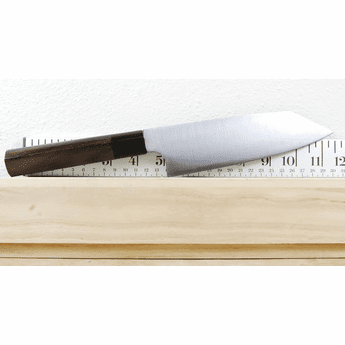
- Weight: 4.1 oz (118g)
- Blade Length: 167mm
- Total Length: 307mm
- Spine Thickness at Heel: 2.6mm
- Blade Height at Heel: 48.7mm




