


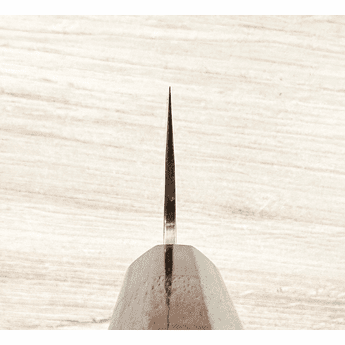


What sets Nao Yamamoto apart from other respected blacksmiths in Echizen is not just the quality of his steel selection or his finishing work - it is the geometry. His mastery of the Nimai-Hiroge forging technique produces blades that are measurably thinner than the field, and that thinness is not decorative. It reduces resistance through the cut, improves food release off the flat, and makes the knife feel lighter and faster in the hand than its dimensions suggest. Over 20 years of production in one of Japan most demanding knife-making regions has refined every detail of how Yamamoto-san approaches the work.
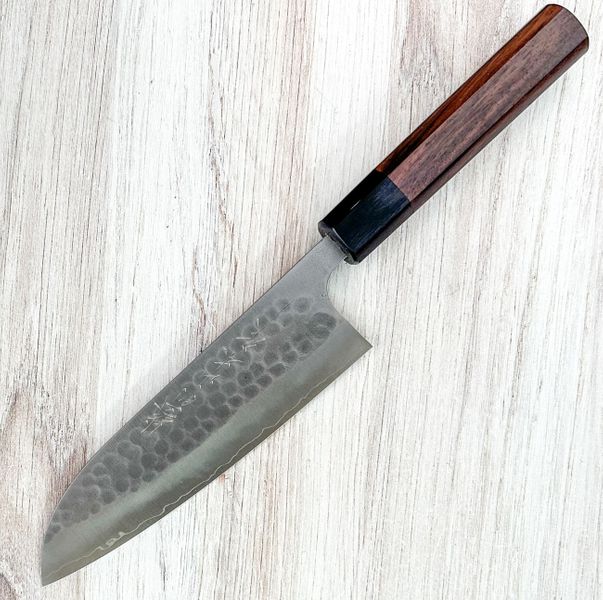
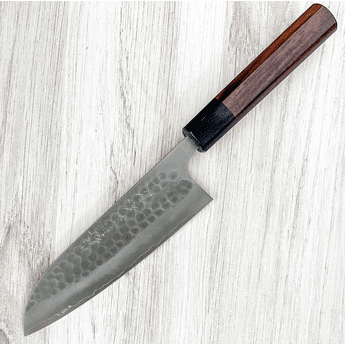
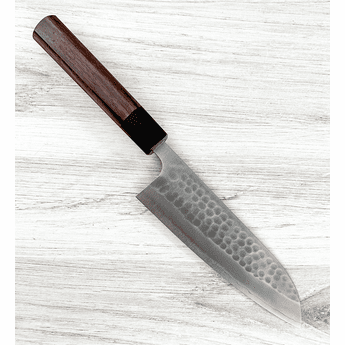
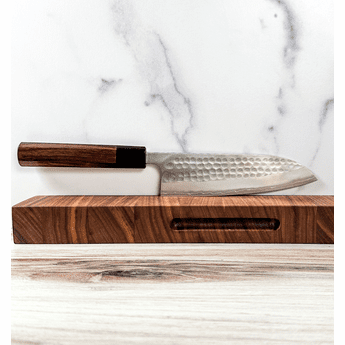
The santoku (three virtues) is Japan all-purpose chef knife - designed from the ground up to handle meat, fish, and vegetables with equal capability - and at 170mm this one hits the format at its most versatile. The Ginsan (Silver #3) stainless core delivers a sharpening experience that rivals carbon steel while remaining genuinely low-maintenance in daily use: no reactive patina to manage, no oil required for storage, no special handling around acidic ingredients. The stainless tsuchime (hammered) cladding adds food release and gives the blade road a textured, handmade appearance that photographs as well as it performs. The hand engraving is a detail that speaks to the level of individual attention each knife receives. The rosewood octagonal handle with pakka ferrule is well-matched to the format - comfortable in both pinch and handle grips, and finished cleanly at the ferrule joint.
Care Instructions: Ginsan stainless is low maintenance but rewards good habits. Hand wash and dry promptly after use - avoid the dishwasher. Sharpen on quality water stones to maintain the edge geometry Yamamoto-san builds into each blade. Use wood or plastic cutting boards and store away from other utensils to protect the tip and edge. Free shipping over $100.
The santoku (three virtues) is Japan all-purpose chef knife - designed from the ground up to handle meat, fish, and vegetables with equal capability - and at 170mm this one hits the format at its most versatile. The Ginsan (Silver #3) stainless core delivers a sharpening experience that rivals carbon steel while remaining genuinely low-maintenance in daily use: no reactive patina to manage, no oil required for storage, no special handling around acidic ingredients. The stainless tsuchime (hammered) cladding adds food release and gives the blade road a textured, handmade appearance that photographs as well as it performs. The hand engraving is a detail that speaks to the level of individual attention each knife receives. The rosewood octagonal handle with pakka ferrule is well-matched to the format - comfortable in both pinch and handle grips, and finished cleanly at the ferrule joint.
Care Instructions: Ginsan stainless is low maintenance but rewards good habits. Hand wash and dry promptly after use - avoid the dishwasher. Sharpen on quality water stones to maintain the edge geometry Yamamoto-san builds into each blade. Use wood or plastic cutting boards and store away from other utensils to protect the tip and edge. Free shipping over $100.
- Blacksmith: Nao Yamamoto
- Location: Echizen, Japan
- Construction: San Mai, Hammer Forged
- Edge Steel: Ginsan (Silver #3) Stainless
- HRC: 61
- Cladding: Stainless
- Finish: Tsuchime (Hammered)
- Edge Grind: Even
- Handle: Rosewood Octagonal
- Ferrule: Pakka Wood
- Engraving: Hand Engraved
- Weight: 4.9 oz (140 g)
- Blade Length: 170 mm
- Total Length: 314 mm
- Spine Thickness at Heel: 3 mm
- Blade Height: 48 mm




