




The Tanaka family has been forging blades in Omura City, just outside Nagasaki, for four generations. Their craft traces its roots back over 800 years to refugees who settled in the region following the Battle of Dannoura - one of the decisive naval conflicts of medieval Japan. Katsuto Tanaka carries that tradition forward today at Tanaka Kama Kogyo, producing knives that reflect centuries of forge-welded craft in a region most buyers associate with history rather than cutlery.
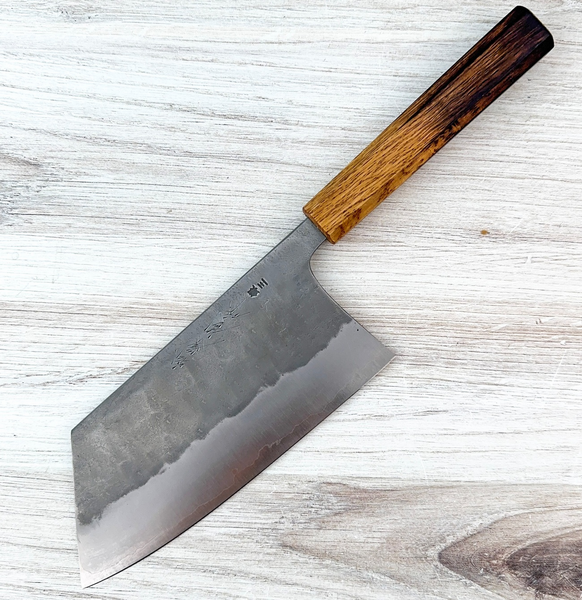
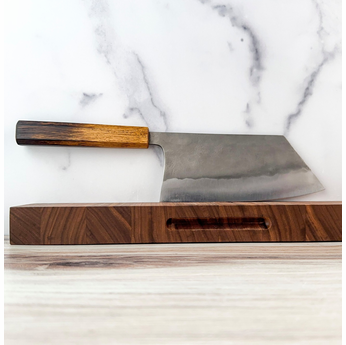
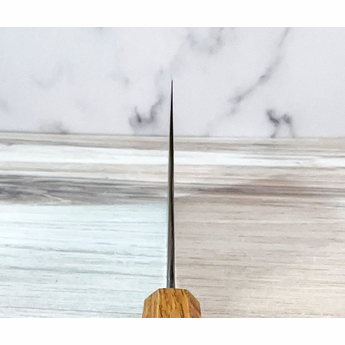
This version of the 190mm kiri cleaver is crafted from the same Ginsan Silver #3 core and features the same nashiji stainless cladding, but is paired with a lighter octagonal oak handle without a ferrule. The tapered tanto tip makes fine cuts and dicing possible in a knife with full cleaver blade height. The even, double-bevel grind will suit both right- and left-handed users.
Care Instructions: Ginsan (Silver #3) is a fully stainless steel - low maintenance and resistant to corrosion. Hand wash and dry after each use. Avoid the dishwasher, and use wood or rubber cutting boards. Avoid bones, frozen foods, and hard materials. Sharpen on quality water stones - Ginsan at 62 HRC sharpens more easily than most stainless and takes a fine edge that rivals carbon steel.
Each knife is made by hand so measurements may vary.Blacksmith: Katsuto Tanaka
Workshop: Tanaka Kama Kogyo
Location: Omura City, Nagasaki Prefecture, Japan
Construction: Hammer Forged, San Mai
Edge Steel: Ginsan (Silver #3) Stainless Steel
Cladding: Stainless
HRC: 62
Finish: Nashiji (Pear Skin)
Edge Grind: Even (50/50), Double Bevel
Handle: Octagonal Oak Wood
Weight: 8.4 oz (238 g)
Blade Length: 190 mm
Total Length: 350 mm
Spine Thickness at Heel: 4 mm
This version of the 190mm kiri cleaver is crafted from the same Ginsan Silver #3 core and features the same nashiji stainless cladding, but is paired with a lighter octagonal oak handle without a ferrule. The tapered tanto tip makes fine cuts and dicing possible in a knife with full cleaver blade height. The even, double-bevel grind will suit both right- and left-handed users.
Care Instructions: Ginsan (Silver #3) is a fully stainless steel - low maintenance and resistant to corrosion. Hand wash and dry after each use. Avoid the dishwasher, and use wood or rubber cutting boards. Avoid bones, frozen foods, and hard materials. Sharpen on quality water stones - Ginsan at 62 HRC sharpens more easily than most stainless and takes a fine edge that rivals carbon steel.
Each knife is made by hand so measurements may vary.




