


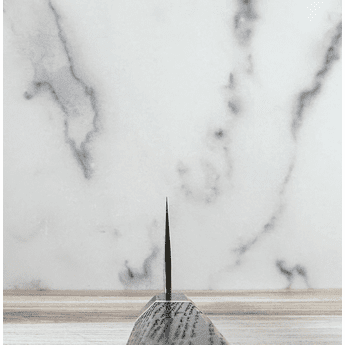


Makoto Coreless VG-10 Santoku 165mm
Handcrafted by Makoto Kurosaki in Echizen’s Takefu Knife Village, this coreless VG-10 santoku reflects a refined balance of traditional Japanese craftsmanship and modern performance. Makoto-san trained under master smith Hiroshi Kato and is widely respected for his clean blade geometry, precise heat treatment, and exceptional sharpening skills.
The blade is made from VG-10 stainless steel, a premium cutlery alloy developed by Takefu Special Steel Co., valued for its fine grain structure, strong edge retention, and straightforward sharpening characteristics. Heat treated to approximately 60–61 HRC, VG-10 offers an excellent balance of sharpness, durability, and ease of maintenance for everyday kitchen use.
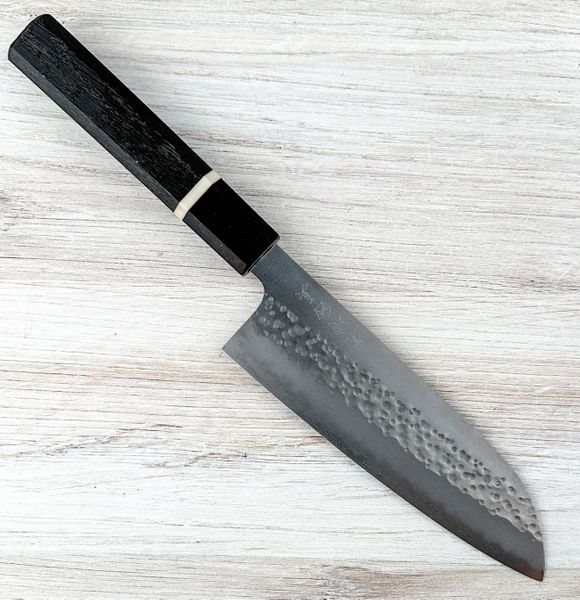
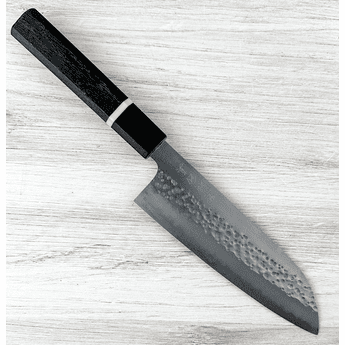
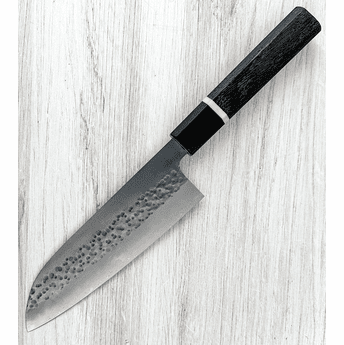
This santoku features a coreless stainless Damascus construction with a subtle tsuchime (hammered) finish. The layered cladding creates visual depth while helping reduce food adhesion during cutting. The san mai construction places the VG-10 core at the center of the blade for cutting performance, supported by softer outer layers that improve toughness and stability.
Makoto-san’s reputation as a sharpener is evident in the refined grind and edge quality. The knife arrives ready to use, with smooth cutting feel and balanced handling that make it well suited for slicing, dicing, and chopping a wide range of ingredients.
The handle is crafted from 4,000-year-old bog oak, paired with a blackwood ferrule and a faux ivory spacer. This combination adds visual character while providing a comfortable grip and excellent balance in hand.
Care Instructions: Hand wash only and dry immediately after use. Avoid cutting frozen foods, bones, or other hard materials. Use a wooden or soft synthetic cutting board to preserve the edge. Store in a saya, blade guard, or other protective cover when not in use.
Handcrafted by Makoto Kurosaki in Echizen’s Takefu Knife Village, this coreless VG-10 santoku reflects a refined balance of traditional Japanese craftsmanship and modern performance. Makoto-san trained under master smith Hiroshi Kato and is widely respected for his clean blade geometry, precise heat treatment, and exceptional sharpening skills.
The blade is made from VG-10 stainless steel, a premium cutlery alloy developed by Takefu Special Steel Co., valued for its fine grain structure, strong edge retention, and straightforward sharpening characteristics. Heat treated to approximately 60–61 HRC, VG-10 offers an excellent balance of sharpness, durability, and ease of maintenance for everyday kitchen use.
This santoku features a coreless stainless Damascus construction with a subtle tsuchime (hammered) finish. The layered cladding creates visual depth while helping reduce food adhesion during cutting. The san mai construction places the VG-10 core at the center of the blade for cutting performance, supported by softer outer layers that improve toughness and stability.
Makoto-san’s reputation as a sharpener is evident in the refined grind and edge quality. The knife arrives ready to use, with smooth cutting feel and balanced handling that make it well suited for slicing, dicing, and chopping a wide range of ingredients.
The handle is crafted from 4,000-year-old bog oak, paired with a blackwood ferrule and a faux ivory spacer. This combination adds visual character while providing a comfortable grip and excellent balance in hand.
Care Instructions: Hand wash only and dry immediately after use. Avoid cutting frozen foods, bones, or other hard materials. Use a wooden or soft synthetic cutting board to preserve the edge. Store in a saya, blade guard, or other protective cover when not in use.
- Brand: Makoto
- Blacksmith: Makoto Kurosaki
- Location: Takefu, Japan
- Construction: San Mai
- Method: Hammer Forged
- Quenching: Water Quenched
- HRC: ~60–61
- Finish: Kasumi with Tsuchime Damascus Cladding
- Edge Steel: VG-10 Stainless Steel
- Handle: Bog Oak
- Ferrule: Blackwood
- Weight: 5.1 oz (146 g)
- Blade Length: 166 mm
- Total Length: 306 mm
- Spine Thickness at Base: 2 mm
- Blade Height: 49 mm
- Edge Grind: Even / Double Bevel




